Meditation Tools
Meditation is not one technique. It is a family of practices that work with attention, observation and inner inquiry in different ways. The right tool depends on what you are working with and what you are trying to develop.
Practical meditation approaches from the DeepYogaWay method — not about emptying the mind.
Not emptying the mind.
Learning to observe it.
The most common misconception about meditation is that the goal is a quiet mind — a state without thoughts. This misunderstanding leads many people to conclude they “cannot meditate” because thoughts keep arising. But thoughts arising is not failure. It is what minds do.
In the DYW approach, rooted in Jñana Yoga — the path of self-inquiry and clear seeing — meditation is the primary tool for developing inner awareness. Inspired by the Yoga Sutras of Patanjali’s understanding of dhyana, the goal is not the absence of thought. It is the capacity to observe thought — to see what is arising without being immediately swept away by it, and to find in that space of observation the possibility of genuine self-knowledge.
Milana describes it precisely: meditation is not about not having thoughts. It is about being able to observe, investigate and find new answers that will expand our system.
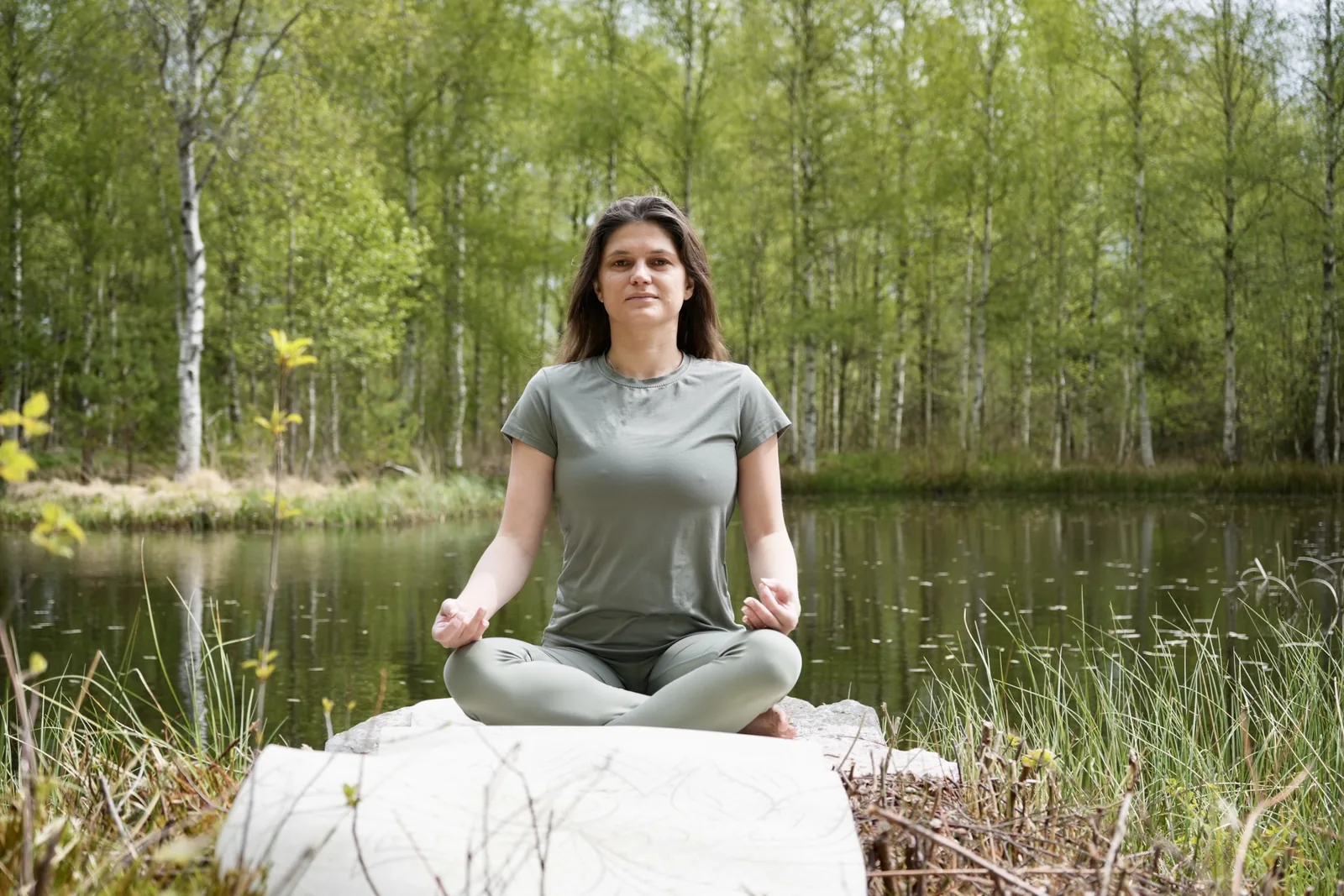
Meditation techniques
used in the DYW practice
Breath Awareness
Using the sensation of the breath as an anchor for attention. When attention wanders — and it will — the practice is simply to notice that it has wandered and return to the breath. This is the core meditative action, practised again and again. It builds the fundamental capacity: noticing where attention is.
Witnessing Practice
Sitting as the observer of thoughts, emotions and sensations rather than as the content of them. The witness does not try to change what arises — it simply sees it. Over time, this develops a stable observing quality that persists even in challenging situations off the mat.
Self-Inquiry (Atma Vichara)
Holding a genuine question in the field of attention — not analysing it, but staying with it in an open, receptive way. In the DYW context, these questions often concern real desires, direction, patterns and the deeper nature of one’s own consciousness. The aim is not to generate answers but to develop the quality of honest inner listening — the capacity Jñana Yoga places at the centre of all practice.
Dharana (Single-Pointed Focus)
Choosing a single object — a candle flame, a mantra, a specific sensation in the body — and returning to it whenever attention wanders. Dharana precedes dhyana in the classical yoga sequence and develops the foundational capacity for sustained inner attention.
Deep Rest Practice
A guided practice that moves the body into deep physiological rest while a thread of awareness remains. In the DYW method, this is one of the most accessible ways to develop the quality of inner quiet — resting the body completely while maintaining a gentle, observing awareness.
Moving Meditation
Slow, attentive movement — asana practised with meditation quality — in which the body becomes the object of sustained attention. For many people, moving meditation is more accessible than seated practice as a starting point, because it gives the attention something physical to anchor to.
“It is not about not having thoughts. It is about being able to observe, investigate and find new answers that will expand our system.”
A tool we use to influence
our consciousness with certain goals.
Milana’s definition of meditation is precise: “It is a certain tool that we use to influence our consciousness with certain goals.” Not a state of relaxation. Not the absence of thought. A tool. With specific developmental purposes. This distinction matters — it is the difference between meditation as something that happens to you and meditation as something you do with intention.
She identifies distinct forms: analytical meditation (dhyana — considering all options, learning), bhavana (a conscious choice to live and realize), cathartic (dynamic), creative (the sustained observer stance). Each serves a different purpose and requires a different quality of attention. In DYW sessions, meditation is integrated throughout — not appended at the end as a relaxation.
“Meditation can be considered successful if the practitioner has gained some new knowledge about themselves or the world which allows them to really change their life internally and/or externally.” Not a feeling of peace during the session. A real change in understanding that carries into how one lives — into relationships, decisions, and the quiet moments of everyday life. This is the standard DeepYogaWay holds for meditation. It is also the standard Jñana Yoga has always held: that practice exists to produce insight, and insight exists to be lived.
Go deeper
The full DYW explanation of what meditation is and how it works.
Practice Deep Rest PracticeThe deepest meditation tool in the DYW practice.
Tools Reflection PracticeMoving inner observation into language and insight.
Programs Intro SessionLearn meditation with Milana in person.
Meditation is best learned
in the room, not from a screen.
The intro session includes guided meditation — with Milana present to support whatever arises. No experience needed. Just the willingness to sit and see.