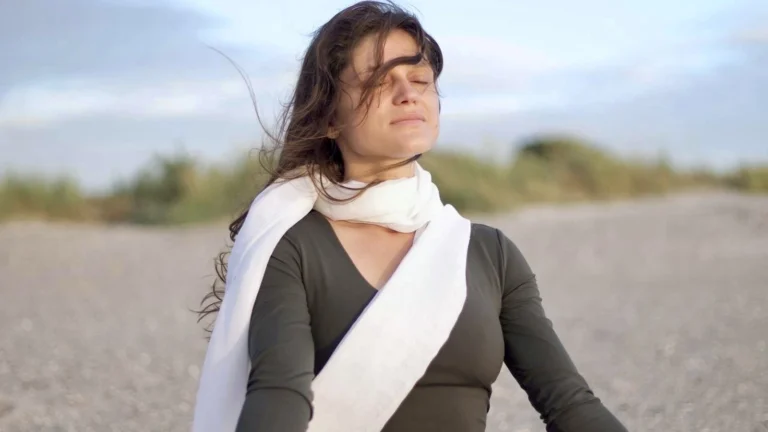

Most of us spend most of our time above the neck.
Thought, analysis, planning, evaluation. Language. The inner narrator commenting on everything. The mind busy with its endless project of figuring out, managing, anticipating.
The body, in this arrangement, becomes a vehicle — something that transports the mind from place to place, that needs to be fed and exercised and occasionally rested. Not a source of intelligence. Not a doorway into anything deeper. Just a functional system that mostly operates in the background until something goes wrong.
Embodied yoga practice begins with the simple, radical proposition that this is backwards.
What embodiment actually means
Embodiment is not a concept. It is not a posture or a technique. It is a quality of relationship with physical experience — a kind of listening, from the inside, to what is actually happening in the body, right now.
Most people, when they first encounter real embodiment practice, discover that they have been living at a significant remove from their own bodies. They can describe how they feel emotionally, in abstract terms. But ask them to locate a sensation — where in the body does that emotion actually live? What is its texture, its quality, its movement? — and the question draws a blank.
This is not unusual. It is, in fact, the default mode for most people who have grown up in modern culture, which systematically privileges mind over body, thought over sensation, abstraction over direct experience.
Embodied yoga practice is, among other things, a process of returning from that abstraction to the reality of physical experience.
The body as intelligence
The body is not a passive recipient of the mind’s instructions. It is an intelligent system in its own right — one that carries information, holds history, processes experience, and communicates through sensation and impulse.
When we slow down enough to listen to it, the body has a great deal to say.
This is not mystical. It is functional. The body holds the residue of experience — including experiences that were never fully processed, never fully moved through. Tension patterns in the shoulders or the jaw. A habitual holding in the belly. A chronic bracing in the lower back. These are not random. They are the body’s way of managing what the mind could not.
Embodied yoga practice is, in part, a practice of gently bringing attention to these patterns — not to fix them, not to force them to change, but to make contact with them. To bring conscious awareness into territory that has been operating on autopilot.
When that contact is made, something becomes possible. Not always immediately, not always dramatically, but real: a gradual softening, a release, a greater ease of movement that was not available before.
Asana as inquiry, not performance
In modern yoga culture, asana — the physical poses — are largely practiced as performance. The question is: can I achieve this shape? Can I go deeper into this pose? Can I hold this balance longer than last time?
This framing is not without value. It develops certain qualities — strength, flexibility, coordination. But it misses something fundamental.
When asana is practiced as inquiry rather than performance, the question changes entirely. The question is no longer: what can I achieve? It becomes: what is here? What is this body doing? What does it feel like, from the inside, to be in this shape? Where is there ease? Where is there holding? What happens when I bring genuine attention to this particular corner of my experience?
This shift — from performance to inquiry, from achievement to exploration — is one of the fundamental moves in the DeepYogaWay approach to asana. The poses become a context for somatic investigation rather than a measure of physical accomplishment.
And what is discovered through that investigation is often surprising: places of unexpected ease, patterns of unconscious holding, the direct experience of how breath, sensation and emotion are not separate systems but a single, integrated field.
When sensation and emotion meet
One of the things that can happen in genuine embodied practice — and that does not happen in performance-based practice — is the meeting of sensation and emotion.
The body holds emotional material. Not metaphorically, but literally. Grief lives in the chest. Anger in the jaw and the fists. Fear in the belly. This is not a figure of speech. It is somatic reality.
When we bring genuine attention to physical sensation — particularly sensation in areas where something is chronically tight or braced — we sometimes encounter the emotional content that the body has been holding there.
This does not need to be dramatic. It does not need to be cathartic. Often it is quiet: a recognition, a softening, a sense of something releasing that has been held for a long time.
The capacity to be with this — to meet what arises in the body without immediately suppressing it or being overwhelmed by it — is one of the most significant things that develops in sustained embodied yoga practice. It is also, not coincidentally, one of the most valuable capacities a human being can have in navigating a life.
This is the thread that connects embodied practice to the deeper work of self-inquiry. In Jñana Yoga — the philosophical foundation of the DeepYogaWay method — the body is not a detour on the way to consciousness. It is the entrance. The path from sensation to self-knowledge runs directly through learning to feel what is actually here.
The return to the body
The invitation of embodied yoga practice is simple, even if the practice itself is not always easy.
Come back to the body. Not as a destination, not as a performance, not as a project. But as the place where experience actually lives — where breath moves, where sensation speaks, where aliveness is felt directly, without the mediation of concept or story.
This is the beginning of something. And, in another sense, it is the whole thing.