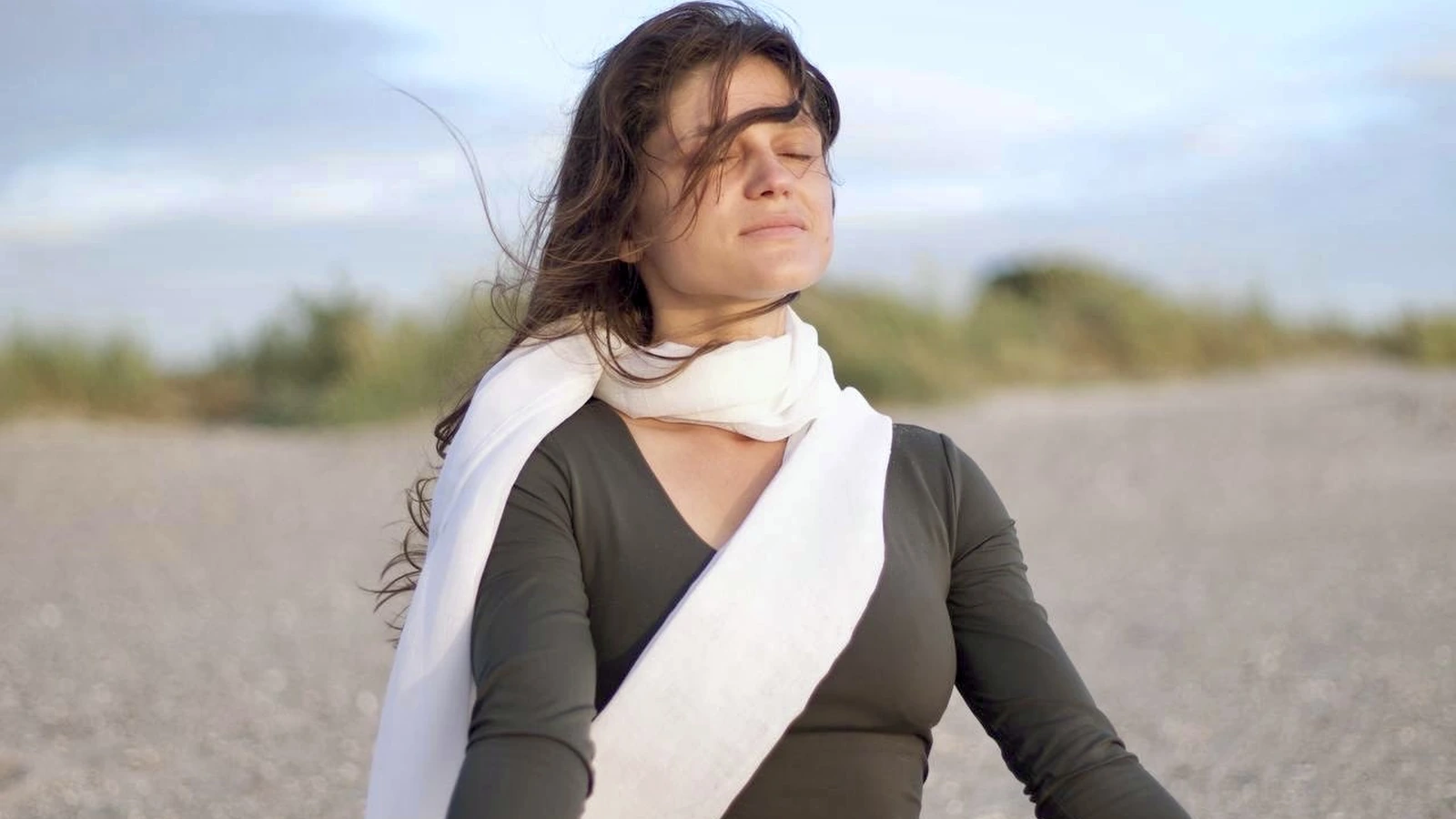
There are three things that are always available to you, in every moment, regardless of circumstances.
Your breath. Your body. Your awareness.
These are not small things. They are, in a sense, everything. They are the only things you can ever truly work with directly — because they are the only things that are always present, always now, always accessible.
The DeepYogaWay method is built around these three — not as a philosophy, but as a lived practice. As tools that can be taken up, worked with, refined over time, and carried into every corner of daily life.
The breath: the bridge
The breath occupies a unique position in the body’s systems. It is one of the few autonomic processes — processes that operate without conscious direction — that can also be brought under voluntary control.
You do not have to remember to breathe. The body does it for you, thousands of times a day, without any conscious input. But you can, at any moment, choose to breathe differently. Slower. Deeper. More consciously.
This double nature — automatic and voluntary, unconscious and available to awareness — makes the breath an extraordinary bridge. Through it, we can access and influence the autonomic nervous system. We can shift states that would otherwise be beyond our reach.
Extended exhalation activates the parasympathetic nervous system — the branch associated with rest, restoration and digestion. A ratio of exhalation to inhalation of 2:1 produces measurable calming effects within minutes. Breath retention, applied carefully and with good instruction, can produce profound shifts in consciousness. Kapalabhati and other energising practices raise metabolic rate, clear the mind and build heat.
None of this is metaphor. It is physiology.
But the even deeper work of breathwork — pranayama, in the yogic tradition — is not primarily about these technical effects. It is about developing a relationship with the breath as a living process: feeling it move through the body, noticing how it changes with emotional state, learning to use it as an anchor when the mind is agitated or the nervous system is overwhelmed.
The practitioner who has a genuine relationship with their breath has access to a resource that is always present, always available, always capable of supporting a return to themselves.
The body: the ground
If the breath is the bridge, the body is the ground.
Everything that happens in human experience happens in a body. Emotion is felt in the body. Memory lives in the body. Trauma is held in the body. Sensation, impulse, aliveness — all of this is body.
And yet most of us live at a significant remove from our own bodies. We think about our bodies rather than inhabiting them. We manage them, train them, treat them — but rarely listen to them with genuine attention.
Embodied yoga practice is, at its foundation, a practice of return. A return to the direct experience of being in a body, right now, in this moment. Not the idea of the body, not the concept of sensation, but the actual felt reality of weight, breath, heat, aliveness.
This return is not always comfortable. The body holds things. Tension that has accumulated over years. Emotions that were never fully processed. Patterns of bracing and protecting that once served a purpose and have outlived it.
When we bring genuine attention to these held places — not with the intention of fixing them, but simply of making contact — something becomes possible. The body begins to speak. And what it says, when we are patient and present enough to listen, is almost always worth hearing.
The body also offers something that the mind cannot: immediate feedback. The mind can tell us stories, justify positions, maintain comfortable fictions. The body does not lie in quite the same way. It tightens when something is wrong. It releases when something is right. It knows things that the thinking mind cannot access.
Learning to read this — to work with the body’s intelligence rather than around it — is one of the core skills developed in the DeepYogaWay method.
Awareness: the space in which it all happens
The third door is different in kind from the first two.
Breath and body are objects of awareness — things that can be attended to, felt, worked with. Awareness itself is the space in which all of this happens. It is the capacity to notice — to observe experience without being completely absorbed by it, without being identified with it to the point of losing perspective.
This is what is sometimes called the witness: the part of us that can watch the mind worry without being the worry; that can feel the anger without becoming the anger; that can be present with grief without being destroyed by it.
Awareness, in this sense, is not detachment. It is not a stepping back from experience into some cool, uninvolved observation post. It is a quality of presence that allows full contact with experience — feeling it completely — while also maintaining some thread of recognition that this is happening to a being who is larger than this particular experience.
This capacity does not appear all at once. It is developed, slowly, through practice. Through meditation. Through the repeated practice of noticing — noticing the breath, noticing sensation, noticing thought, noticing the quality of attention itself.
Over time, this develops into something more stable: a background awareness that is present even in difficult moments, even when the mind is agitated or the body is in pain. A kind of spaciousness that holds everything without being overwhelmed by any of it.
This is what Jñana Yoga — the path of self-inquiry at the core of the DeepYogaWay method — has always worked toward. Not awareness as a technique. As a way of being. A quality of inner seeing that becomes available in ordinary moments, not only on the mat.
How the three work together
The deepest work in yoga practice does not happen when these three are cultivated separately. It happens when they are integrated — when breath, body and awareness are brought into contact with each other simultaneously, in a living field of attentive experience.
This is what meditation, in its deepest sense, is: not the elimination of thought, but the cultivation of a quality of presence that holds body, breath and awareness in simultaneous, living contact.
The DeepYogaWay sessions are structured to support this integration. The session arc — arrival, body practice, breathwork, nervous system work, meditation, integration — is not arbitrary. Each element prepares the ground for the next. By the time meditation arrives in the session, the body is genuinely settled. The breath is genuinely free. Awareness has been trained and invited rather than simply commanded to appear.
The practical invitation
None of this requires special talent, extraordinary flexibility, or years of previous experience. What it requires is showing up — consistently, over time, with genuine attention.
The three doors are always open. The breath is here. The body is here. Awareness, when we turn our attention to it, is here.