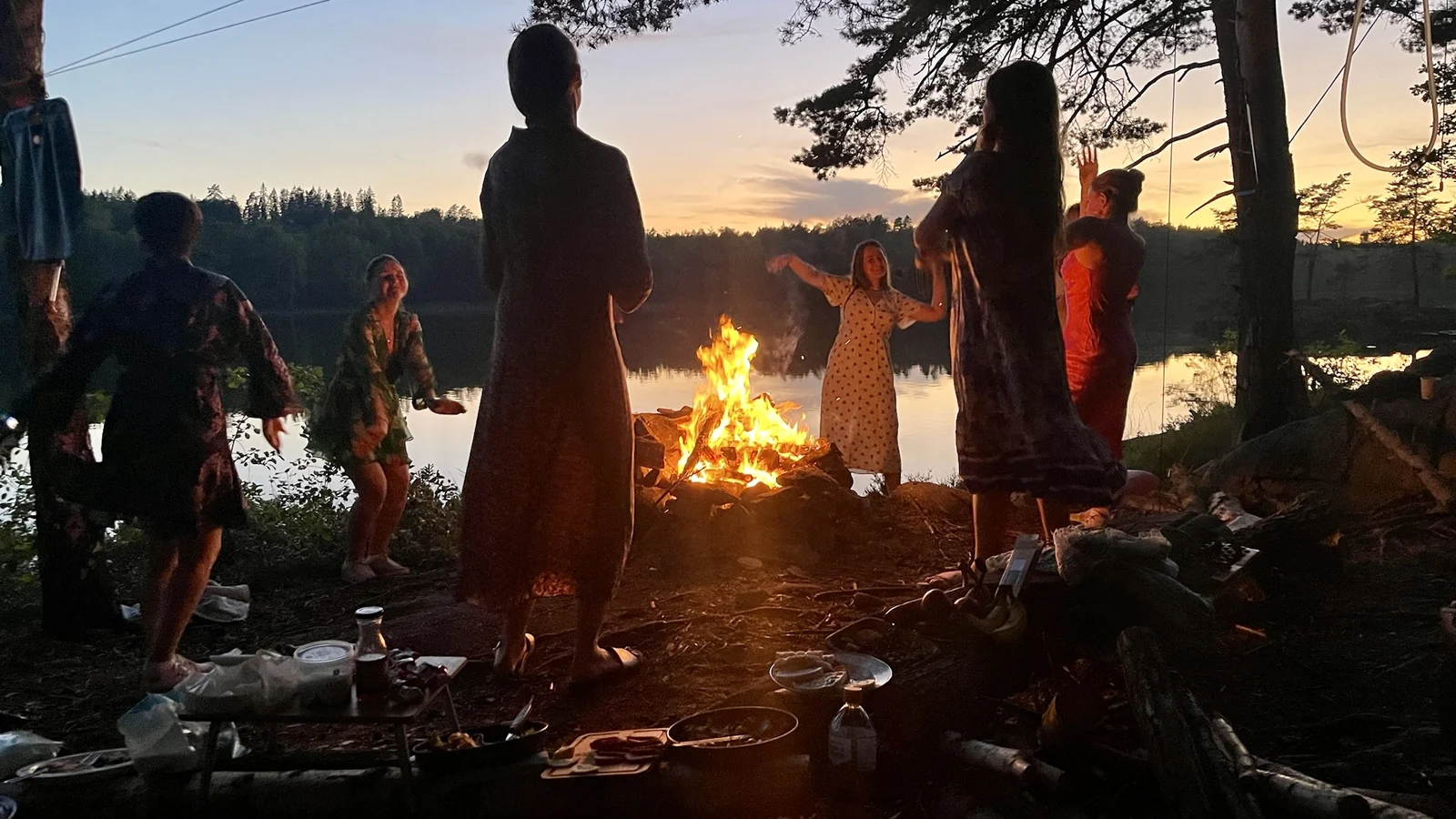
The group is not just a setting. It is a tool.
This is one of the things that is hardest to understand before you have experienced it — and one of the things that becomes most obvious once you have. The people around you in practice are not incidental to your work. They are part of it.
This is why DeepYogaWay works with fixed, ongoing groups — not rotating lineups of whoever happened to book a slot that week, but the same people, the same rhythm, week after week.
What makes a group fixed?
A fixed group means that you commit to practice with the same people for the duration of your membership. The group does not change from session to session. New people do not join mid-cycle. Existing members do not drop in and out at will.
This structure is not a logistical choice. It is a methodological one.
When the same people practice together, consistently, over months, something develops that cannot be replicated in a drop-in class: a shared field. A collective settling. A quality of mutual recognition that goes beyond the social.
The group as a container
The concept of a container is central to how we work at DeepYogaWay. A container is a bounded, held space within which something can develop that would not develop in the open air.
A fixed group provides this. The boundaries — who is in the group, when we meet, how we practice together — create the conditions for depth. Within those boundaries, trust accumulates. Vulnerability becomes possible. The practice goes to places it cannot reach alone, or in a room full of strangers.
This is not a small thing. Many people have been to yoga classes for years without ever experiencing this quality. Not because the classes were bad, but because the structure was not designed to produce it.
Co-regulation and shared rhythm
One of the most significant things that happens in an ongoing yoga group practice is co-regulation — the process by which nervous systems regulate each other through shared presence.
This is a well-established phenomenon in developmental psychology and neuroscience. We do not regulate our nervous systems entirely on our own. We are inherently social creatures, and our bodies respond to the presence and states of others — particularly in conditions of safety and shared intention.
When the same group of people has been practicing together for months, this co-regulation becomes very precise. The group settles together. The individual who arrives agitated is gently held by the group’s collective groundedness. The person who is struggling is supported by the field, even without words.
This is invisible when you first join a group. It becomes tangible over time.
What develops that individual practice cannot provide
Individual practice — a home practice, a daily meditation — is valuable and important. But it has limits that group practice can transcend.
In group practice, you meet yourself in relation. You notice how you contract when you are witnessed. You discover what happens when someone else’s presence requires you to be more present. You learn — slowly, somatically, in the body rather than in the mind — how to be with others without losing yourself.
These are not small learnings. They are some of the most important capacities a human being can develop. And they are only available in genuine relational practice.
Milana describes it directly: people in the group discuss, mirror each other, become friends on the spiritual path. This is not a side effect of the practice. It is part of what the practice is. Jñana Yoga — the self-inquiry at the core of the DeepYogaWay method — has always understood that we know ourselves more clearly in relation to others than we ever can alone.
The group also holds accountability. When you know that the same people will be there next week, your relationship to showing up changes. The practice is not just yours — it belongs to something larger. This creates a quality of commitment that is difficult to manufacture in solo practice.
Why ongoing matters as much as fixed
A fixed group is not enough on its own. The group also needs to be ongoing — to meet regularly, over a sustained period, without a defined endpoint.
This is because the depth of what becomes available in group practice is not immediate. It accumulates over sessions, over months, over seasons. The first weeks are often a period of settling, of establishing safety, of learning to trust the container. The real work often begins somewhere in the second or third month.
A six-week course, however well-designed, cannot produce what six months in a fixed ongoing group can produce. The timeline is different. The process is different. The outcomes are categorically different.
Not for everyone — and that is fine
Fixed ongoing group yoga practice is not the right fit for everyone at every stage of life. It requires a level of commitment — to attendance, to the group, to the process — that not everyone is ready for.
This is not a criticism. Readiness is real, and it matters. There are times when a drop-in class is exactly what is needed. There are times when individual work is the right thing.
But for those who sense that there is more available — more depth, more real change, more genuine development — a fixed ongoing group is often where that possibility lives.
If you feel drawn to this kind of practice, we would love to hear from you.